

Do you know the level of process maturity in your organization?
Process management is much more than mapping workflows and modeling processes. While this is indeed a fundamental part, it is a practical discipline that analyzes, designs, implements, manages, and transforms processes with the goal of achieving results more closely aligned with strategic objectives. Understanding your level of process maturity is part of this journey.
Process maturity measures the degree of structuring, documentation, control, and optimization of a company’s work routines, highlighting its ability to deliver consistent, efficient, and predictable results.
It is also used to assess the maturity level of an organization’s process management, its degree of control and governance, how organized its processes are, how continuous improvement initiatives are applied, and whether its focus remains strategic and aligned with overall planning objectives.
Why Assess Process Maturity Levels?
Understanding the level of process maturity within your organization is essential to ensure that everything continues to operate smoothly, to prevent the same mistakes from recurring over time, to ensure deadlines are met, and to support the continuous improvement of delivery quality.
Knowing the current state of your company’s processes enables the definition of the changes required for progression through maturity levels.
The higher the level of process maturity, the greater the efficiency and scalability, the lower the need for rework, the stronger the governance and predictability, and the greater the real-time visibility of the entire operation.
Conversely, the lower the level of process maturity, the higher the likelihood of process improvisation, increased rework due to lack of standardization and control, and slower decision-making caused by the absence of reliable data. All of this results in disorganization and reduced team efficiency.
Even so, it is important to recognize that assessing maturity means identifying that processes within the same organization may be at different levels and therefore require specific improvements.
Understand the Levels
The levels are identified through an assessment and are divided into five stages according to widely used maturity models in the market.
1 – Initial
This level indicates a management model with a low degree of organization and is considered unstructured. This means that employees do not follow a standard way of performing the same activities, nor are there predefined standard documents in place.
2 – Managed or Repeatable
This level indicates that the organization has already advanced in process maturity. This is identified by the existence of processes that produce predictable, consistent, and repeatable results.
However, not all employees within the organization are aware of these processes and documentation, which leaves room for errors and inconsistencies in daily operations.
3 – Defined
The main characteristic of this level is the existence of standardized and documented internal routines established by responsible managers.
However, knowledge of these routines is still limited to those directly involved, even in processes that include cross-functional teams.
4 – Predictable
This level is characterized by the ability to easily measure and analyze existing processes, as well as compare them with competitors and other industry leaders.
5 – Optimized
The highest and final level refers to organizations whose processes are already in a continuous improvement phase. Due to their maturity, errors can be eliminated quickly, and documentation is updated accordingly.
Communication issues, which are more common in lower maturity levels, occur less frequently at this stage.
How to Identify Your Company’s Current Level?
The identification of process maturity levels can be carried out through assessments based on process maturity models.
The first models emerged in the 1990s, following a request from the U.S. Department of Defense for the creation of a method to evaluate suppliers. This was followed by the Fisher Model in 2004, the Rosemann and de Bruin Model in 2005, the Hammer Model in 2007, the OMG Model in 2008, the CMMI Model in 2010, the Gartner Model in 2013, and the Robledo Model in 2014.
At Interact, for example, we use the Robledo Model as the basis for the questionnaire available in Interact Flow.
Free Process Maturity Assessment in Interact Flow
Interact Flow is Interact’s free solution that enables both workflow modeling and the assessment of an organization’s process management maturity.
Available at no cost, the Process Management Maturity Model is inspired by the model created by Pedro Robledo, a BPM expert, president and co-founder of ABPMP Spain, and professor at the International University of La Rioja (UNIR).
The questionnaire is based on seven key pillars: processes, personas, methodologies, strategy, technologies, governance, and culture. These pillars are dynamically interconnected, ensuring a comprehensive and detailed analysis of any organization.
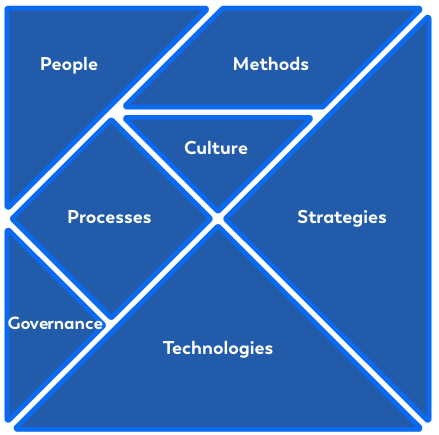
After completing the assessment, the results should serve as a guide for your organization’s planning.
The solution also provides artificial intelligence tools that can suggest actions to help advance your processes through the maturity levels.
Take the assessment now and start evolving through the maturity stages.
And if you want to deepen your knowledge on the topic, we offer a free eBook—download it by clicking here.