
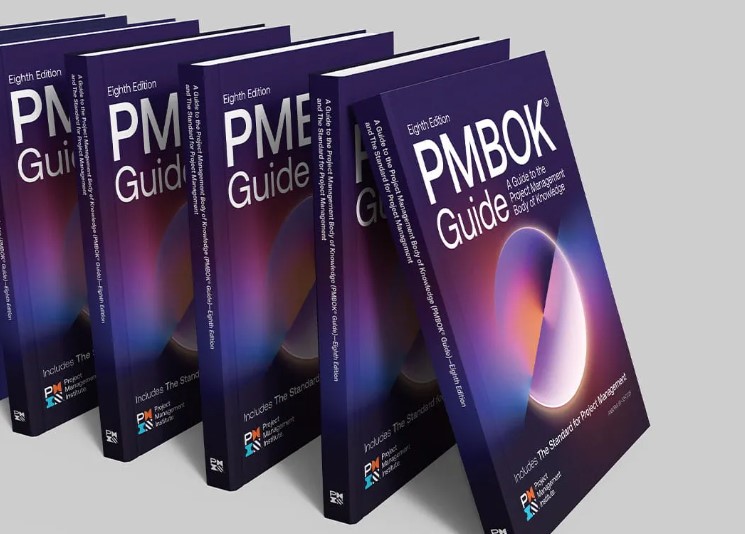
I attended the official launch of PMBOK 8 at the PMI Global Summit 2025 in Phoenix, Arizona, and to me, this edition represents a milestone in project management maturity. It does not replace PMBOK 7, nor does it return to the structure of the 6th edition — instead, it integrates and expands upon both, providing clarity and applicability in any value-driven context.

Bernardo Zurli, Vice President of the PMI Rio Grande do Sul Chapter
PMBOK 7 marked a necessary shift, enabling the evolution of the prescriptive, waterfall-oriented paradigm. However, it also generated questions about how to combine its principles and performance domains with the operational, day-to-day work that was previously well-defined (even if many considered it bureaucratic). This was evident when, following its release, PMI published the Process Guide to complement the standard.
PMBOK 8 addresses this issue by indicating how to apply the value delivery system in practice—across daily operations—without losing adaptability or the holistic perspective required for different contexts.
1) PMBOK 8 – The Transition
PMBOK 8 preserves the conceptual pillars of the 7th edition—especially principles, value, and domains—while restoring operational clarity by integrating processes and focus areas. It is not a rollback; in my view, it is an integrative advancement.
One of the most significant changes is the updated definition of a Project. It may seem minor, but adding the word “value” to the definition changes everything:
“A project is a temporary endeavor, within a unique context, undertaken to create value.”
This emphasis strengthens the profession’s ongoing transition: we move away from speaking solely about scope, schedule, and cost, and shift toward measuring impact, purpose, and benefit.
As a reminder, PMBOK 7 introduced the Value Delivery System, outlining how organizations generate value. PMBOK 8 now demonstrates how to apply it:
- connects vision, mission, and strategy to project portfolios, operations, and products
- guides decision-making with a focus on what truly creates value
In short: the bridge between strategy → portfolio → execution → benefits is now clear.
2) PMBOK 8 Architecture: Principles, Domains, and Focus Areas
The final structure combines coherence and applicability by bringing together an analysis of three fundamental components—Principles, Domains, and Focus Areas.
6 Fundamental Principles
- Holistic Vision
- Value Focus
- Built-in Quality
- Responsible Leadership
- Integrated Sustainability
- Empowered Culture
7 Performance Domains
- Governance
- Scope
- Schedule
- Finance
- Stakeholders
- Resources
- Risk
The domains now incorporate operational processes, enabling teams to visualize the full management flow within each area.
5 Focus Areas (formerly Process Groups)
They return as foundational anchors:
- Initiating
- Planning
- Executing
- Monitoring and Controlling
- Closing
These are flexible organizers, applicable in any context.
The previous 49 processes have now become 40, integrated within the domains rather than presented as linear lists or prescriptive checklists. They function as practical guidance for those who need to translate principles into actionable work.
3) Central Focus: VALUE as the Primary Metric
PMBOK 8, aligned with the Project Success research conducted by PMI, reinforces that project success lies in delivering value that exceeds effort and cost. This is reflected in three key elements:
3.1 – Value Breakdown Structure (VBS)
A framework that connects:
- desired value
- product scope
- project scope (WBS)
In my view, this integration will be a turning point for current PMOs and portfolio teams. It is possible that the new PMI certification on the horizon may be linked to this shift. Recently, discussions about PMOs, VMOs, and even xMOs have been emerging everywhere, often without a clear understanding—by some—of the real differences between these structures.
3.2 – Built-in Quality and Sustainability
Sustainability has arrived in the new PMBOK to stay. Aligned with PMI’s increasing collaboration with GPM, it becomes integrated into the system rather than addressed in isolated areas. Quality now becomes a guiding focus in everything we do to create value.
3.3 – Explicit Integration of Artificial Intelligence
Addressed in Appendix 2 of the guide, AI is no longer a trend—it is now part of the recommended practices, particularly in:
- planning
- risk analysis
- estimating
- communication
- automated documentation
- decision support
4) Summary Comparison
The synthesis between the editions is now clearer:
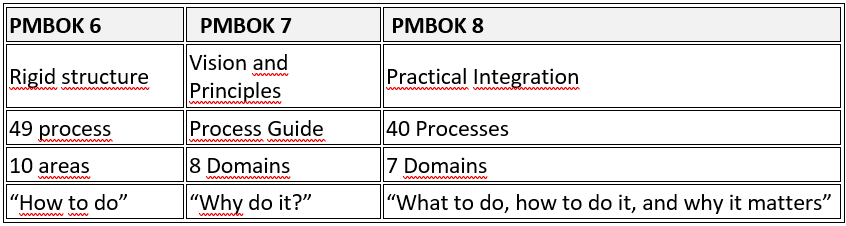
PMBOK 8 organizes, integrates, and clarifies.
5) Strategic Appendices
Expanding the guide’s perspective, PMBOK 8 introduces several highly relevant appendices:
PMO
Connects to the PMO Guide released last year (2024) and demonstrates how the PMO aligns with the Value Delivery System, governance, and the performance domains.
Artificial Intelligence
One of the major advancements. It provides clear guidance on how to use AI throughout every stage of the project lifecycle, with attention to ethics, data, quality, and automation.
Procurement
Consolidates practices related to purchasing, contracting, and suppliers, with a focus on governance, context, contractual risks, and integration with the performance domains themselves.
Conclusion: Projects as Instruments of Transformation
Of course, I still need time to study the new guide in depth. However, based on my first impressions, it seems clear that PMBOK 8 reinforces the idea that projects are not merely deliverables—they are structured mechanisms for generating value. It positions us as professionals capable of connecting strategy, culture, purpose, and execution.
As a PMO/Project Portfolio consultant, I see this edition as the first to truly balance theory with practice and invite us to evolve into professionals who deliver value—not merely activity managers or progress auditors.